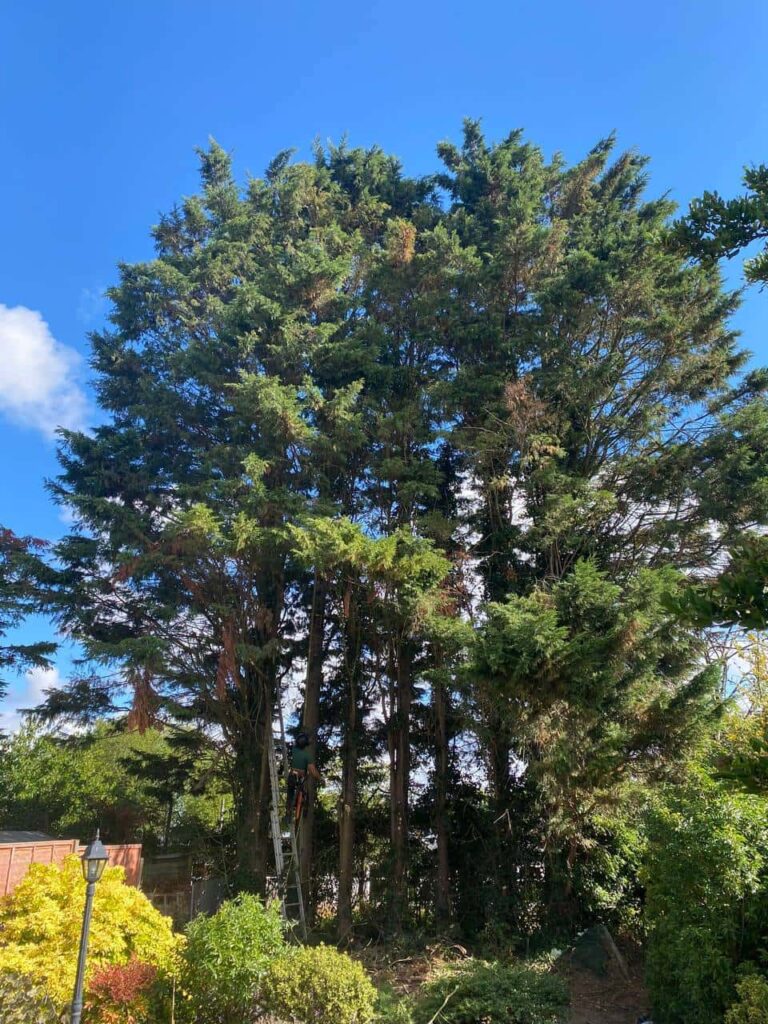
Large tree stumps can occupy a considerable amount of useful garden space long after the tree itself has been removed. They can interfere with landscaping, make lawn maintenance awkward and restrict how an area can be used. Understandably, property owners sometimes wonder whether a particularly wide or established stump is simply too large for stump grinding.
In many situations, large tree stumps can be ground out successfully using suitable professional equipment and an appropriate working method. For property owners in Mundford, Norfolk, the important considerations include the stump’s diameter, height, root flare, accessibility and what you intend to do with the area afterwards.
How Professional Stump Grinding Deals With Large Tree Stumps
Stump grinding uses specialist machinery to progressively reduce the remaining timber rather than attempting to pull the entire stump and root system from the ground in one piece. A rotating cutting wheel works across the stump in controlled passes, breaking the wood into smaller material until the required area has been reduced.
This makes stump grinding suitable for many substantial stumps that would otherwise be extremely difficult to remove manually.
The size of the stump influences how the work is approached, but a large diameter does not automatically prevent grinding from being carried out.
Stump Diameter Is Only One Consideration
It is easy to assume that the width of a stump determines whether it can be ground, but several factors need to be considered together.
A professional tree surgeon will typically assess:
- The overall diameter of the stump
- How far it stands above ground level
- The shape and extent of the root flare
- Access for appropriate stump grinding equipment
- The surrounding ground conditions
- Nearby trees, planting and landscaping
- The intended future use of the area
A very wide stump with straightforward access can sometimes be more practical to deal with than a smaller stump positioned in a restricted location.
Large Stumps Are Usually Reduced Gradually
Grinding a substantial stump is generally a controlled process rather than a single cut.
The machine works progressively across the timber, removing material in stages. This allows the operator to manage the stump methodically while responding to changes in its shape and density.
Large stumps often have substantial root flares extending from the base. These areas can also be considered as part of the work where appropriate.
The objective is to reduce the stump to the level required for the planned use of the space rather than simply removing the most visible central section.
Stump Height Can Affect the Work Required
A stump left particularly high after tree removal contains considerably more timber than one cut closer to ground level.
This does not necessarily prevent grinding, but it changes the amount of material that needs to be processed.
Before stump grinding begins, the remaining stem may sometimes need to be reduced appropriately so the machinery can work efficiently across the stump.
Assessing the stump beforehand allows the correct method to be planned rather than approaching every stump in exactly the same way.
Root Flares Can Make a Stump Appear Much Larger
Mature trees often develop pronounced roots around the base of the trunk. Once the tree has been removed, these root flares can leave a stump occupying a much wider area than the original trunk diameter suggests.
Where necessary, accessible surface roots and prominent root flares can be considered as part of the grinding process.
How much needs to be addressed depends partly on what will happen to the area afterwards. A stump in an unused planted section may have different requirements from one occupying space intended for a lawn or new landscaping.
Establishing the desired finished result beforehand helps determine the appropriate extent of grinding.
Does Stump Grinding Remove the Entire Root System?
Stump grinding and complete root excavation are different processes.
Grinding primarily deals with the stump and relevant accessible roots around the immediate area. A mature tree’s root system can extend considerably beyond the visible stump, and it is not normally necessary to chase and remove every root throughout the surrounding ground.
Once the stump has been reduced, remaining underground roots are generally left in place to break down naturally over time.
This is one reason stump grinding can be a practical method of dealing with large stumps without unnecessarily disturbing a much larger area of ground.
Access Is Particularly Important for Large Stumps
Access can have a significant influence on how stump grinding work is planned.
The operator needs to consider how suitable machinery can reach the stump and whether there is enough working space around it. Narrow entrances, gates, steps, changes in ground level and established landscaping can all affect access.
This does not automatically mean a difficult-to-reach stump cannot be treated.
A professional assessment can establish what equipment is suitable for the available space and whether any preparation is required before work begins.
The Stump’s Position Matters
Large stumps can be found in many different locations, from open lawns to planting areas and close to existing garden features.
The surrounding environment should be assessed before grinding begins. Nearby surfaces, boundaries, planting and other features can influence how the work is carried out.
The objective is to reduce the stump effectively while working carefully within the available space.
This is another reason professional stump grinding should begin with an assessment rather than judging the work solely by the stump’s diameter.
How Deep Does a Large Stump Need to Be Ground?
The appropriate grinding depth depends on the individual stump and what is planned for the area.
If the primary aim is to remove a visible obstruction, the requirements may differ from an area that will subsequently form part of a landscaped garden.
Discussing the intended use of the ground beforehand helps ensure the stump is treated appropriately.
There is little benefit in approaching every stump to an identical depth when different gardens and future plans require different outcomes.
Stump Grinding Can Make Landscaping Easier
One of the main reasons homeowners choose to remove large stumps is to reclaim usable garden space.
A substantial stump can dictate the layout of an entire section of garden. Paths may need to go around it, lawns can be interrupted and new planting or other landscaping may be difficult to plan effectively.
Reducing the stump opens up more possibilities for the area.
Once the work has been completed appropriately, the surrounding space can be considered as part of the wider garden rather than having to design everything around an unwanted tree stump.
Large Stumps Can Make Garden Maintenance Awkward
Even where no immediate landscaping project is planned, a large stump can make routine garden maintenance more difficult.
Grass and vegetation may grow around its edges, making mowing awkward. Exposed roots can interrupt otherwise usable ground, while new shoots may occasionally develop from certain stumps.
Grinding can create a cleaner and more manageable area, particularly where the stump occupies a prominent part of the garden.
The benefit is therefore not purely visual; removing the obstruction can improve how the surrounding space functions.
What Happens to the Material From Stump Grinding?
Grinding produces a mixture of small wood particles and material from around the stump.
The amount generated can be considerable when dealing with a large stump because there is significantly more timber to process.
How the resulting area is managed depends on the stump and the intended finish. This should form part of the planning process so homeowners understand what the site will be like once grinding has been completed.
The important point is that stump grinding reduces a large solid obstruction into material that can be managed much more easily.
Can an Old Stump Still Be Ground?
A stump does not necessarily need to be recently created for grinding to be possible.
Older stumps can remain substantial for a long time, although their condition may change as the timber naturally deteriorates. Some sections may become softer while other parts remain comparatively solid.
An assessment can determine the condition of an older stump and the most appropriate way to approach it.
Leaving a stump for years therefore does not automatically make professional grinding unsuitable.
Why Professional Equipment Makes a Difference
Large stumps contain a significant volume of dense timber, often combined with substantial roots at ground level.
Professional stump grinding machinery is designed specifically to reduce this material in a controlled manner. Appropriate equipment allows the operator to work progressively across the stump rather than relying on methods that are poorly suited to such a substantial obstruction.
Experience is equally important. The operator needs to judge the shape of the stump, surrounding space and working conditions throughout the process.
At Mundford Tree Surgeons, we assess stumps in Mundford, Norfolk individually so that the equipment and approach can be matched to the actual situation.
Why an Assessment Should Come First
Two large stumps of similar diameter can require very different approaches.
One may be located in an open area with straightforward access, while another may have substantial surface roots and restricted working space. The intended use of the ground afterwards can also affect how much material needs to be reduced.
A professional assessment allows these factors to be considered before work starts.
This provides a much clearer understanding of how the stump can be treated and helps ensure the work is appropriate for the surrounding garden.
Conclusion
Large tree stumps can often be ground out successfully. Their size alone does not determine whether stump grinding is suitable. Diameter, height, root flare, access, surrounding features and the intended future use of the area all influence how the work should be approached.
Professional stump grinding can reduce even substantial stumps in controlled stages, removing the main obstruction without needing to excavate the tree’s entire underground root system. The result can make an awkward area easier to maintain and provide greater flexibility for future landscaping.
If you have a large tree stump taking up valuable space in your garden in Mundford, Norfolk, contact Mundford Tree Surgeons. We can assess the stump, surrounding area and access before recommending an appropriate stump grinding approach for your property.
Call us on: 01842 771 096
Click here to find out more about Mundford Tree Surgeons
Click here to complete our contact form and see how we can help with your trees needs.